
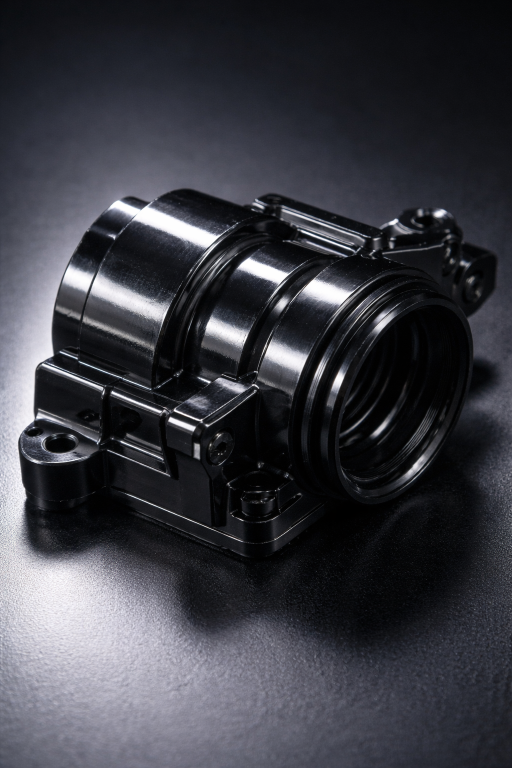
Black plastic parts are widely used in injection molding, consumer products, automotive components, and packaging. While these parts are common, they present unique challenges when designing automated inspection systems.
Dark materials absorb light rather than reflecting it evenly, which makes surface defects difficult to detect using standard lighting approaches. In many cases, improper lighting can hide defects entirely, making reliable inspection impossible.
Careful lighting design is therefore one of the most important aspects of machine vision systems used to inspect black plastic parts.
This article explains the challenges involved and the lighting techniques commonly used to improve defect visibility. It also builds on the inspection concepts discussed in our article on automating inspection of injection molded parts.
Why Black Parts Are Difficult to Inspect
Machine vision systems rely on light reflected from the surface of a part. For many materials, reflected light provides clear contrast that allows cameras to detect edges, textures, and defects.
Black plastics behave differently.
Instead of reflecting light uniformly, they often:
- absorb most of the incoming light
- produce localized glare or reflections
- hide surface defects under low contrast conditions
As a result, defects such as flash, scratches, contamination, or surface deformation may be difficult to distinguish from the surrounding material.
Without proper lighting design, automated inspection systems may fail to detect these defects reliably.
Importance of Lighting in Machine Vision
Lighting is often more important than the camera or software used in an inspection system.
The purpose of machine vision lighting is not simply to illuminate the part. Instead, lighting is used to create contrast between the feature being inspected and the surrounding surface.
For black plastic parts, the goal is usually to highlight subtle changes in surface geometry or reflectivity that indicate defects.
Proper lighting allows the camera to capture images where defects appear clearly and consistently.
Common Defects in Black Plastic Parts
Black plastic components may exhibit several types of defects that require inspection.
- flash along mold parting lines
- surface scratches
- contamination or foreign material
- sink marks
- incomplete features or threads
- burn marks
Because many of these defects involve subtle changes in surface shape, lighting techniques that emphasize surface texture are often required.
Dark Field Lighting
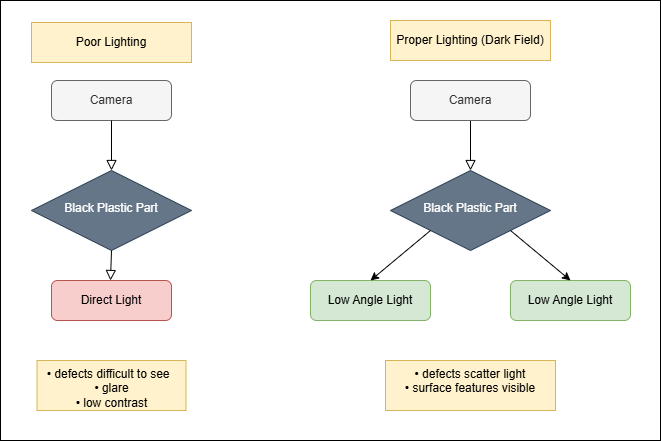
Dark field lighting is one of the most effective techniques for inspecting surface defects on dark materials.
In a dark field setup, light is projected across the surface of the part at a shallow angle rather than directly from above.
This causes small surface features such as scratches, flash, or raised edges to scatter light toward the camera.
Flat surfaces remain dark, while defects appear bright.
Dark field lighting is commonly used to detect:
- flash
- scratches
- raised defects
- burrs
This technique works particularly well for identifying small surface imperfections that may otherwise be difficult to detect.
Dome Lighting
Dome lighting is used when uniform illumination is required across a curved or reflective surface.
In a dome lighting setup, light is reflected from the inside surface of a dome that surrounds the part. This creates very even, diffuse illumination.
Dome lighting helps eliminate harsh reflections and hot spots that may occur with direct lighting.
This technique is often useful when inspecting parts with curved surfaces, glossy finishes, or complex geometries.
Polarized Lighting
Some black plastics produce strong reflections that obscure surface features.
Polarized lighting can be used to reduce these reflections.
In this approach, a polarizing filter is placed on both the light source and the camera lens. By aligning the filters properly, unwanted glare can be significantly reduced.
This allows surface details and defects to become more visible to the camera.
Strobe Lighting for High-Speed Inspection
In high-volume production environments, parts may move quickly through an inspection system.
Strobe lighting is commonly used to freeze motion and produce sharp images.
A strobe light emits a very short, high-intensity burst of light synchronized with the camera exposure. This allows the system to capture clear images even when parts are moving rapidly.
Strobe lighting is frequently used in inspection systems designed for high-speed manufacturing processes.
Combining Lighting Techniques
In many inspection systems, multiple lighting techniques are used together to achieve reliable results.
- dark field lighting to highlight surface defects
- diffuse lighting to reveal part geometry
- strobe lighting to capture images during high-speed motion
Careful experimentation is often required to determine the optimal lighting configuration for a particular part and defect type.
Evaluating Inspection Feasibility
When designing an automated inspection system for black plastic parts, several factors must be considered.
- defect size and visibility
- surface finish of the material
- part geometry
- production speed
- consistency of part orientation
In many cases, testing different lighting configurations is necessary to determine whether defects can be reliably detected using machine vision.
Need Help Evaluating an Inspection Problem?
If your manufacturing process relies on manual inspection of black plastic parts, it may be possible to automate the process using machine vision and custom automation equipment.
You can contact Frogmouth Automation to discuss your application or send photos or video of the process for evaluation.