
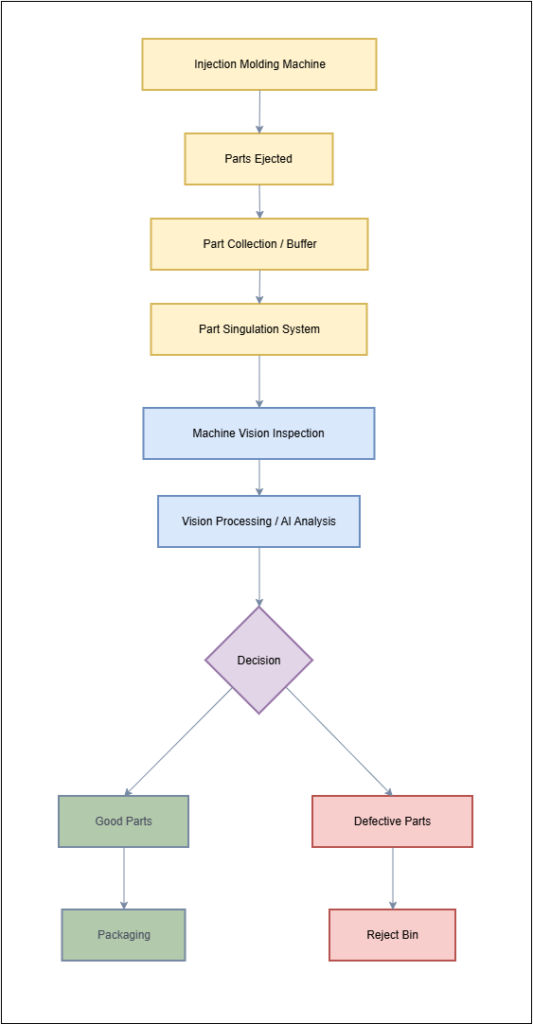
Injection molded parts are often produced in very large quantities, and quality problems can quickly lead to large amounts of scrap if defects are not detected early. Automated inspection systems using machine vision and sometimes AI can detect defects such as flash, short shots, and surface imperfections in injection molded parts. Many manufacturers still rely on manual inspection, where operators visually examine parts and sort good parts from defective ones.
While manual inspection can work at low volumes, it becomes unreliable and expensive in high-volume production environments.
Automated inspection systems can significantly improve consistency, reduce labor costs, and detect process problems before thousands of defective parts are produced.
This article explains the challenges involved in inspecting molded parts and how automated inspection systems are typically designed.
Common Defects in Injection Molded Parts
Injection molding can produce a wide range of defects depending on process conditions, mold condition, and material behavior.
Some of the most common defects include:
- flash along parting lines
- short shots where the mold does not completely fill
- sink marks or depressions
- burn marks
- contamination or foreign material
- deformation or warping
- damaged or incomplete threads
Many of these defects are visual, making them good candidates for camera-based inspection systems.
Why Manual Inspection Often Fails
Many molding operations rely on operators to inspect parts as they come off the machine. A typical process might involve an operator picking up each part, rotating it, and placing it into a good or reject container.
Manual inspection has several weaknesses:
- operator fatigue reduces inspection accuracy
- small defects may be missed
- inspection speed limits production throughput
- inspection quality varies between operators
In high-volume molding operations, defects can go unnoticed for long periods of time, resulting in large quantities of scrap.
Challenges of Automating Inspection
Although automated inspection can improve quality control, injection molded parts present several challenges.
High production rates
Multi-cavity molds can produce large numbers of parts in very short cycle times.
For example, a 32 cavity mold running at a 13 second cycle time produces roughly 2.5 parts per second, meaning an inspection system must handle large part volumes reliably.
Part orientation
Parts are usually ejected from the mold and fall into bins or conveyors. During this process they may tumble or rotate, making it difficult to present them to a camera in a consistent orientation.
Automated inspection systems often require singulation and controlled presentation of parts.
Full 360 degree inspection
Many molded parts are round or symmetrical, such as caps or closures. Inspecting these parts may require viewing the entire circumference of the part.
This can be achieved by:
- rotating the part during inspection
- allowing the part to roll along a track while imaging
- using multiple cameras positioned around the part
Lighting challenges
Lighting is one of the most important aspects of machine vision.
Black plastic parts are particularly challenging because they absorb light and produce reflections that hide surface defects.
Common lighting techniques include:
- dark field lighting to highlight surface defects
- dome lighting to create uniform illumination
- polarized lighting to eliminate glare
- strobe lighting to freeze motion during high-speed inspection
Typical Architecture of an Automated Inspection System
A typical automated inspection system for molded parts may include:
- Part collection and buffering
Parts are collected from the molding machine and fed into the inspection system. - Part singulation
Parts are separated so they can be inspected individually. - Part presentation
Mechanical guides or fixtures ensure that parts are positioned consistently for inspection. - Camera inspection
Industrial cameras capture images of the part while controlled lighting highlights defects. - Defect detection software
Software analyzes the images to determine whether each part meets quality requirements. - Reject handling
Defective parts are automatically diverted from the good product stream.
In many systems, this inspection workflow is combined with custom automation equipment to create a complete handling, inspection, and reject system.
Benefits of Automated Inspection
Automated inspection systems provide several advantages over manual inspection:
- consistent inspection quality
- reduced labor requirements
- early detection of mold or process problems
- reduced scrap and rework
- improved product quality
In many cases, automated inspection systems can pay for themselves quickly by preventing large quantities of defective parts from being produced.
Evaluating Whether Inspection Can Be Automated
Not every inspection task is suitable for automation, but many are.
Key factors include:
- defect type and visibility
- part geometry
- production rate
- required inspection accuracy
If you have a process where operators are currently inspecting parts manually, it may be possible to automate the process using machine vision and custom automation equipment.
When AI-Assisted Inspection Becomes Valuable
Traditional machine vision systems typically rely on rule-based algorithms such as edge detection, thresholding, and geometric measurements. These approaches work well when parts are consistent and defects have clearly defined characteristics.
However, some inspection problems are difficult to solve using rule-based methods. Examples include:
- subtle cosmetic defects
- surface contamination
- unpredictable flash patterns
- complex textures or reflections
In these cases, AI-assisted inspection systems can provide significant advantages.
Instead of relying on fixed rules, AI models learn the visual characteristics of acceptable parts and identify deviations that indicate defects.
This allows inspection systems to detect problems that would be difficult to define using traditional algorithms.
AI-assisted inspection is particularly useful when:
- part appearance varies slightly from cycle to cycle
- lighting conditions are difficult to control
- defect types are difficult to define with simple rules
In many modern inspection systems, traditional machine vision techniques and AI models are combined to provide robust inspection performance.
Need Help Evaluating an Inspection Problem?
If you are dealing with a quality problem or a manual inspection process in your manufacturing operation, it may be possible to design an automated inspection system to improve consistency and reduce scrap.
You can contact Frogmouth Automation to discuss your application or send photos or video of the process for evaluation.